Menu
- About Us
-
Pediatric Dentistry
Preventive & Restorative
Emergency & Sedation
Holistic & Protection
-
Orthodontics
Braces & Aligners
Airway & Sleep

Protecting damaged teeth so your child can chew, speak, and smile comfortably.



Baby teeth hold space for the adult teeth forming underneath, and they help your child chew and speak clearly. Losing one too early can let neighbouring teeth drift into the gap, which crowds the adult tooth trying to come through. A crown keeps the tooth working and in place until it is ready to come out naturally. Link: If a tooth cannot be saved, see Extractions and Space Maintainers.
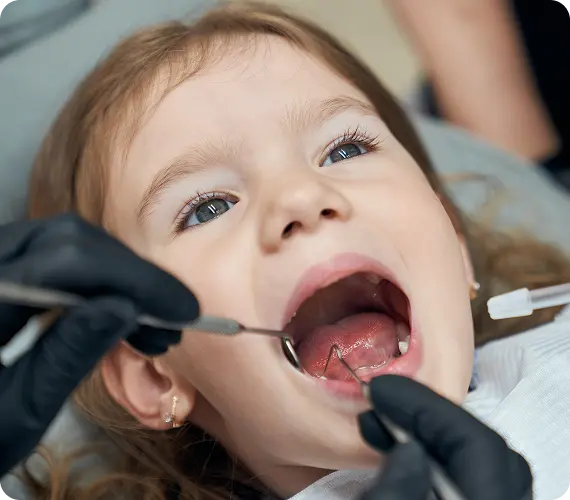

We examine the tooth and take a gentle digital X-ray to see the exact extent of decay or damage.
We numb the area thoroughly so your child stays relaxed and comfortable throughout the procedure.
We remove the decay, clean the tooth, and shape it carefully to receive the protective cap.
We fit the crown, cement it securely, and check the bite. Most crowns are completed in a single visit!
Compassionate pediatric dental care designed to keep every child’s smile healthy, happy, and growing strong.
Back teeth take stainless steel crowns that stand up to heavy daily chewing. They fit precisely, resist wear, and protect posterior molars until they fall out naturally.
Front teeth take tooth-coloured porcelain or ceramic crowns that blend in naturally with surrounding teeth, so your child feels confident when smiling and talking.




When decay or damage is too large for a filling to hold, a crown covers and protects the whole tooth. It is a stronger, longer-lasting fix that keeps the tooth working.
No. We numb the area first, so your child should feel pressure but not pain. Some tenderness afterwards is normal and settles quickly.
A crown on a baby tooth is designed to last until that tooth falls out naturally. With good brushing and regular checkups, it usually does exactly that.
It depends on the tooth. Front teeth can take tooth-coloured crowns that blend in. Back teeth often use stainless steel, which is stronger where chewing pressure is highest.